Summary:
Australian not-for-profit organisations are increasingly experimenting with AI, but many struggle to move beyond pilots to measurable impact. This article explores how charities, NFP leaders, board members and executives seeking to understand how to adopt AI responsibly with the right governance, data foundations, and ethical guardrails, strengthening compliance, building trust, and delivering real community benefits. From low-cost use cases to board-level metrics, it outlines a practical path for using new technology in ways that align with mission, funding realities, and regulatory expectations.
Artificial intelligence is no longer a fringe experiment in the not-for-profit sector. From automating donor communications to streamlining reporting and service delivery, AI tools are quietly finding their way into everyday operations.
But while experimentation is rising, impact remains uneven.
Many not-for-profit organisations are trialing AI in pockets, often driven by individual teams or enthusiastic staff, without the governance, data foundations, or strategic clarity needed to deliver lasting value. For boards and executives, this creates a tension: how to embrace innovation without compromising trust, compliance, or mission.
The opportunity now is not more pilots. It’s responsible, mission-aligned adoption that proves value to funders, members, regulators, and the communities NFPs exist to serve.
“What we’re seeing across the sector is a lot of enthusiasm, but very little structure,” says Raji Haththotuwegama, National Solutions Advisor - Data, AI and Apps. "Many NFPs are already using AI day to day, but without a clear strategy, governance framework, or way to measure impact, those tools rarely move beyond experimentation.”
This article is for not-for-profit leaders, board members, and executives seeking to understand how to adopt AI responsibly to maximise community impact while maintaining compliance and trust.
For not-for-profit organisations, responsible AI is not about adopting the latest tools or experimenting at scale. It means using technology in a way that is ethical, compliant, cost-conscious, and aligned to purpose while making the most of existing investments.
In practice, responsible AI starts with understanding what systems, platforms, and licenses an organisation already has, and how existing features can be used more effectively. It prioritises privacy, transparency, and human oversight, while avoiding unnecessary spend, duplicate tools, or additional licenses that don’t deliver clear value.
For boards and executives, responsible AI means confidence: knowing where data lives, how decisions are supported, how risks are managed, and how technology spend contributes directly to mission and community impact, not overhead.
“Responsible AI isn’t about buying more technology,” says Raji.
“It’s about using what you already have more deliberately, with the right governance, controls, and focus on outcomes.”
The state of play: AI adoption in not-for-profits
Across Australia, charities and community groups are increasingly using AI to support:
- Content creation and grant writing
- Donor engagement and segmentation
- Volunteer coordination
- Enhancing service delivery and 'self-service' client support
- Administrative automation and reporting
According to the ICDC (2025), 76% of not-for-profit organisations have experimented with AI, yet only 3% have made a strategic investment aligned to organisational goals. Most sit in an ad hoc middle ground, tools are in use, but without shared standards, governance, or long-term planning.
This maturity gap is understandable. Many registered charities operate under tight funding constraints, complex legal structures, and heightened public scrutiny. Unlike profit organisations, NFPs must show that income, assets, and services are applied solely to a charitable purpose and public benefit, not personal gain or distributed profit.
The result? Cautious experimentation without scale.
Why impact stalls: The real barriers NFPs face
The challenge is not a lack of intent. It’s a combination of structural, financial, and operational constraints that make responsible AI adoption harder for the sector.
Many not-for-profits operate complex technology environments built up over time, often with overlapping tools, under-used licenses, and cloud services that were never optimised for cost or scale. Without visibility across systems and spend, organisations may be paying for functionality they don’t use, while missing opportunities to unlock value from tools they already own.
This is where AI initiatives can stall, not because the technology is too expensive, but because it's disconnected from governance, cost management, and the broader operating model.
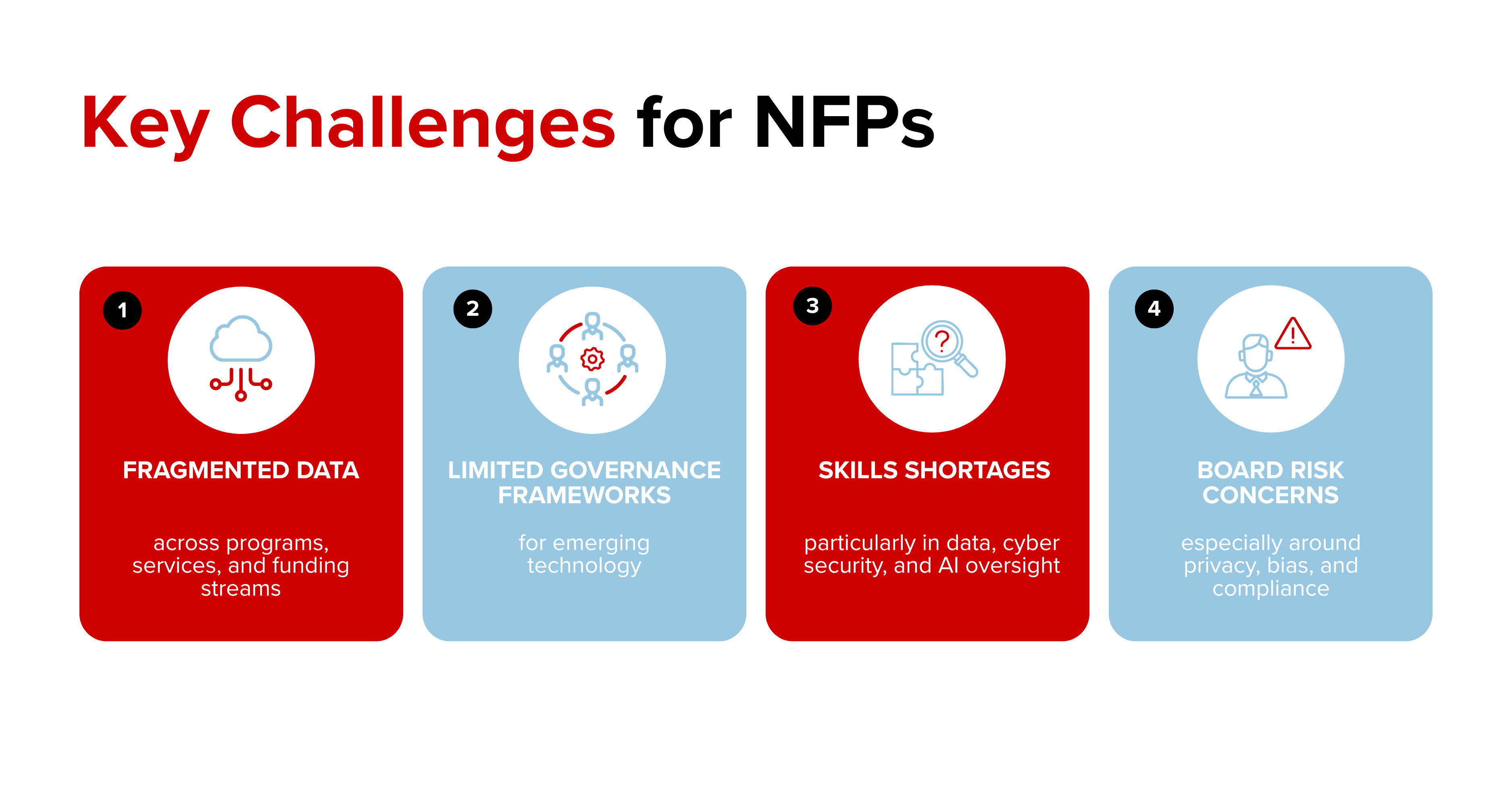 Cyber risk is a growing pressure point. In 2025, cyber incidents affecting Australian charities increased by 48%, prompting boards to demand stronger oversight and clearer accountability (ACNC, 2025). Yet only 22% of not-for-profits currently have a formal AI policy, according to the Infoxchange Digital Technology in the Not-for-Profit Sector Report.
For organisations already navigating tax laws, deductible gift recipient obligations, income tax concessions, and reporting to the Australian Taxation Office, unmanaged AI can feel like one risk too many.
“Boards are right to be cautious. AI introduces real considerations around privacy, compliance, and cyber risk, particularly for organisations handling sensitive client or donor data. The issue isn’t whether to use AI, but how to put the right guardrails around it.”
Raji Haththotuwegama, National Solutions Advisor - Data, AI, and Apps.
Responsible adoption starts with guardrails, not tools
Responsible AI adoption doesn’t begin with software selection. It begins with governance — practical, proportionate, and fit for purpose. For not-for-profit organisations, responsible AI is about ensuring technology supports people, protects trust, and aligns with mission, without introducing unnecessary cost or complexity.
Effective guardrails typically focus on six core principles.
1. Fairness
AI systems should treat all people fairly.
For NFPs, this means ensuring AI-supported decisions such as donor segmentation, service prioritisation, or eligibility assessments do not unintentionally disadvantage particular groups or individuals. Regular review and human oversight help ensure outcomes remain aligned to charitable purpose.
2. Reliability and safety
AI systems should perform reliably and safely across different contexts.
Not-for-profits often operate in complex, high-risk environments. Responsible adoption means understanding where AI is appropriate, testing systems before scaling, and ensuring critical services are not dependent on unproven or poorly understood tools.
3. Privacy and security
AI systems must respect privacy and protect sensitive data.
This is especially important for organisations working in areas such as health services, aged care, disability support, and community care. Data minimisation, access controls, and clear ownership are essential particularly when using AI features embedded within existing platforms.
4. Inclusiveness
AI systems should empower everyone and engage all people, regardless of background or ability.
For NFPs, inclusiveness means ensuring technology does not exclude people with disability, limited digital access, or language barriers. Responsible AI supports equitable access to services rather than creating new points of friction or exclusion.
5. Transparency
AI systems should be understandable to the people who rely on them.
Boards, staff, and stakeholders need clarity on how AI supports decisions and where its limitations lie. Clear documentation and explainable outputs help build trust and confidence, particularly when AI is used to inform funding, engagement, or service decisions.
6. Accountability
People must remain accountable for AI-supported decisions.
Defined ownership, review processes, and audit trails ensure humans stay in control. Accountability frameworks help organisations meet regulatory obligations and maintain confidence among funders, regulators, and the community.
In practice, not-for-profit organisations that combine AI automation with clear ethical principles and basic governance controls often see significant efficiency gains including meaningful reductions in administrative effort while maintaining donor trust and compliance.
“Responsible AI doesn’t mean slowing innovation,” notes Raji. “It means being clear about where AI adds value, where human oversight is essential, and how decisions can be explained to boards, regulators, and the community. When those foundations are in place, adoption actually becomes easier.”
Responsible AI also requires discipline around cost and complexity. This includes regularly reviewing licensing, cloud consumption, and vendor overlap to ensure technology spend remains proportionate to impact. For many NFPs, meaningful savings can be achieved by simplifying environments, retiring unused features, and configuring existing platforms more effectively without compromising security or compliance.
“Responsible AI and cost control go hand in hand,” notes Raji.
"When organisations understand their environment, they can reduce waste, improve performance, and create capacity for innovation without increasing spend.”
Quick wins: Low-cost, high-impact use cases
For many not-for-profit organisations, the greatest value comes not from new tools, but from getting more out of existing investments.
Most NFPs may already have access to AI-enabled features within their current platforms, often included as part of existing licenses or cloud services. The opportunity lies in assessing what is already in place, enabling under-used capabilities, and simplifying environments to reduce cost and complexity.
“The biggest wins we see rarely involve buying new software,” says Raji.
“They come from reviewing what organisations already pay for, reducing duplication, and configuring existing tools to work harder for the mission.”
Practical, low-cost use cases include:
Automated impact reporting using existing platforms
Many reporting and productivity tools already include AI-assisted summarisation and data analysis features. When configured correctly, these can reduce manual reporting effort, improve consistency, and support board and funder reporting, without additional licenses.
Volunteer rostering and workforce planning optimisation
AI-driven scheduling features within existing systems can help organisations better match skills, availability, and demand. This improves service continuity while reducing administrative effort and reliance on manual coordination.
Donor segmentation and engagement using current CRM tools
Many donor management platforms already include predictive or AI-supported insights that are underutilised. Leveraging these features can improve engagement and campaign performance without increasing technology spend.
Licensing and cloud cost optimisation
By assessing existing environments, many NFPs uncover opportunities to reduce licensing, consolidate tools, and manage cloud consumption more effectively. These savings can then be reinvested into frontline services or capability uplift.
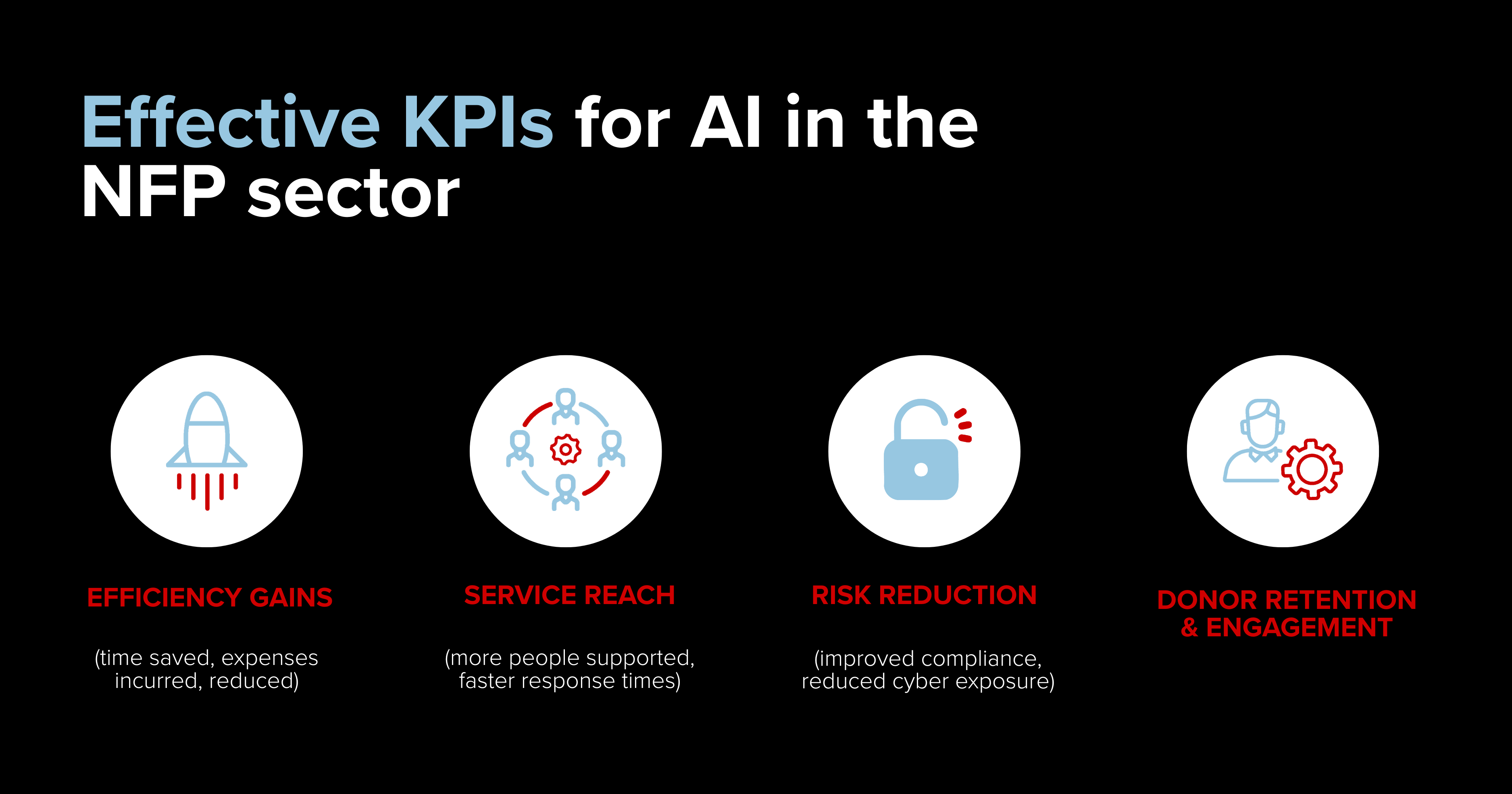
Each of these examples focuses on doing more with what is already in place, improving efficiency, service reach, and sustainability without introducing new cost or risk.
Measure what matters: Proving value to boards and funders
As expectations rise, boards, government agencies, and funders increasingly expect evidence that technology investments deliver measurable benefit.
“Funders and boards want clarity, not hype,” says Raji. “When NFPs can show how AI improves efficiency, reduces risk, or expands service reach, the conversation shifts from ‘why are we doing this?’ to ‘how do we scale it responsibly?"
Insights from Philanthropy Australia’s 2025 Philanthropy Compass, alongside broader sector trends, point to an increasing expectation among funders for transparent, data-driven reporting that goes beyond outcomes to show how organisations operate and govern technology.
Templates, dashboards, and standardised metrics make this easier, especially when AI initiatives are tied directly to mission and charitable purpose, rather than isolated innovation projects.
“Boards increasingly want to see how technology investments reduce cost as well as improve outcomes,” says Raji.
“Demonstrating savings alongside impact builds confidence and supports long-term sustainability.”
Empower purpose with the right technology partner
AI is a powerful tool, but for not-for-profit organisations, its true value lies in how responsibly it's applied.
With the right governance, clear focus, and proportionate investment, AI can strengthen financial sustainability, improve services rendered to communities, and help organisations operate with greater confidence in an increasingly complex regulatory environment.
This is where the right partner matters.
Canon Business Services ANZ works alongside Australian charities, social enterprises, and community organisations to move beyond pilots, helping leaders embed responsible AI into secure, compliant, and mission-aligned operating models. The focus is not technology for its own sake, but technology that amplifies impact.
We support not-for-profits to assess their existing environments, optimise technology spend, and enable responsible AI adoption, helping organisations reduce cost while improving impact.
“Technology should never pull an organisation away from its mission,” says Raji. “Our role is to help NFPs use AI in a way that strengthens trust, supports compliance, and delivers measurable impact without losing sight of the people and communities they exist to serve.”
Ready to move from pilots to real-world impact?
AI adoption doesn’t have to be risky, expensive, or overwhelming.
With the right support, not-for-profit organisations can use new technology responsibly, building trust, demonstrating value, and delivering measurable benefit to the communities they serve.
Partner with Canon Business Services ANZ to ensure your AI journey is ethical, effective, and aligned to your mission, now and into the future.
Supported by: